Hidden on Maps? Here’s the real problem (and why it’s happening in Venice)
You’re excellent at what you do. But when someone searches “near me” on the Island, you’re not showing up, or you’re buried under bigger brands and directories.
That’s the frustrating part about local SEO here in Venice: the market looks small on paper, but the real audience is bigger than you think. Between seasonal residents, retirees, beach visitors, and folks coming down from Sarasota and the surrounding communities, search is often the new word-of-mouth.
And the rules have changed fast. In the last year, Google has pushed more results into Maps, more answers into AI summaries, and more decisions into “just pick one” scrolling behavior. If your presence isn’t clean and convincing, you get skipped.
We believe local SEO should feel like a simple, repeatable system, not a tech overwhelm spiral.
“Why aren’t we showing up in the Map Pack?”
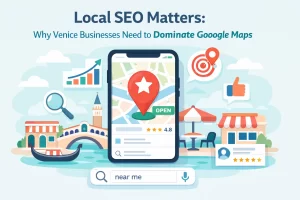
The “Map Pack” is the set of 3 local businesses you see under the map when you search something like:
- “plumber venice fl”
- “best lunch venice”
- “ac repair near me”
- “boutique on venice island”
If you’re not in that top group, you’re basically competing for leftovers.
Most of the time, you’re missing one (or more) of these pillars:
- A fully optimized Google Business Profile
- Consistent business info (NAP) across the web
- Location-focused pages and content on your site
- Real reviews and review responses
- Local authority (citations + backlinks)
- A fast, mobile-first website that doesn’t fight the user
Let’s break it down in plain English.
Nail your Google Business Profile (the #1 local SEO lever)
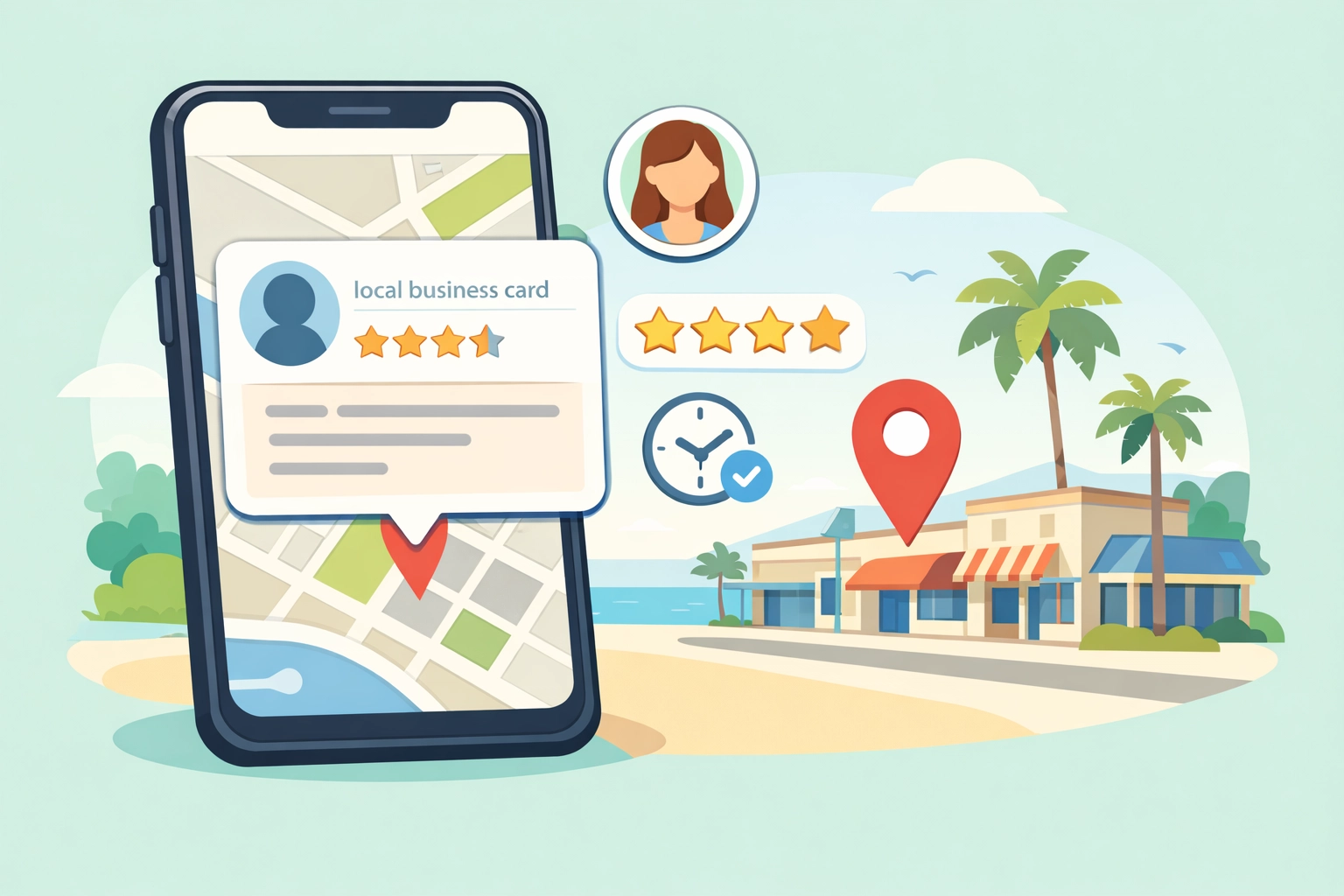
Your Google Business Profile (GBP) is your digital storefront in Venice. It’s what shows up in Maps. It’s what people tap when they want directions, hours, photos, reviews, and a quick “vibe check.”
If you do nothing else this month, do this.
Your GBP optimization checklist (the stuff that actually moves rankings)
Start with accuracy and completeness:
- Business name exactly as it appears in the real world (no keyword stuffing)
- Correct address (or service area settings if you travel to customers)
- Phone number and website link
- Hours (including holiday and seasonal updates)
- Primary category + a few relevant secondary categories
Then add trust signals:
- Business description written for humans (not search engines)
- Products/Services filled out with clear, specific offerings
- Fresh photos (interior, exterior, team, work, before/after)
- Q&A section seeded with common questions (and real answers)
Finally, post consistently:
- Weekly updates or offers (even short ones)
- Seasonal posts (snowbird season, summer specials, events)
“We updated our profile photos and services, and calls started coming in within weeks.”
That’s a common story, because Maps visibility is often the fastest win.
Confused by “NAP consistency”? Here’s the simple version
NAP = Name, Address, Phone number.
Google cross-checks your business info across the internet. If your address is written five different ways (Suite vs. Ste, “Venice Island” vs. “Venice,” old phone number on a directory you forgot about), it chips away at trust.
Quick NAP cleanup plan (do this once, then maintain it)
- Pick your official format (exact spelling, punctuation, suite format)
- Audit your main citations (Google, Apple Maps, Bing, Yelp, Facebook)
- Fix the big directories and any niche listings in your industry
- Update your website footer and contact page to match exactly
Pro tip: if you’ve moved locations in the last few years, this matters a lot. Old addresses can hang around like ghosts.
“What keywords should we target in Venice?” (without sounding spammy)
Local keywords aren’t just “Venice FL + service.” They’re also how people actually search when they’re trying to solve a problem fast.
Start with three keyword buckets
1) Core service + location
- “roof repair venice fl”
- “venice fl massage”
- “family dentist venice fl”
2) Service + neighborhood/area
- “venice island hair salon”
- “near downtown venice fl”
- “south venice handyman”
3) Problem-based searches
- “ac not cooling venice fl”
- “emergency plumber near me”
- “best brunch venice”
Here’s the key: don’t cram these phrases everywhere. Build pages and content that naturally answer what people want.
Your website might be the reason you’re losing leads (even if you rank)
Let’s be honest, here in South West Florida, a ton of local business websites are stuck in 2012. They “exist,” but they don’t convert. And now, Google cares about user experience more than ever.
Fast, mobile-first sites… win.
Mobile-first design: what “good” looks like in 2026
When someone lands on your site from Maps, you’ve got about 5 seconds to help them:
- understand what you do
- trust you
- take the next step (call, book, request)
Make it easy:
- Click-to-call button that stays visible on mobile
- Short headline that says exactly what you do and where
- Simple services list (no walls of text)
- Proof: reviews, photos, certifications, “as seen in…”
- One clear CTA per page (not five competing buttons)
Speed and structure (the non-glamorous stuff that matters)
Local SEO loves boring fundamentals:
- Compress images (huge impact)
- Clean navigation (no menu chaos)
- Clear heading structure (H1, H2, H3)
- Internal links between related pages
- Location signals in page titles and meta descriptions
If you want a baseline reference for how we think about clean, conversion-friendly marketing, check out Island Marketing here: https://veniceislandmarketing.com/index.html
Build location pages that don’t feel fake
If you serve multiple areas (Venice, Nokomis, Englewood, North Port…), you might need location pages. But the old approach, copy/paste the same page and swap the city name, doesn’t work anymore.
Google’s smarter. And honestly, customers can smell it.
A “good” Venice location page includes:
- A short, clear intro: who you help + what you do in Venice
- Specific services offered in this area
- Photos of your work/team locally (real beats stock)
- A mini FAQ section (pricing, timing, what to expect)
- Embedded map or service area details (when appropriate)
- A couple internal links to related services
Think: helpful, specific, local. Not templated and generic.
Reviews: stop treating them like a nice-to-have
Reviews are a ranking factor and a conversion factor. In Venice especially, people lean heavily on reputation because so many choices look similar at a glance.
The simple review system we like (because it actually gets done)
- Ask at the right moment (right after a win, job complete, great meal, successful appointment)
- Send a direct link to your Google review form
- Use a short script your team can repeat
- “If you had a good experience, would you mind leaving us a quick Google review? It really helps local customers find us.”
- Respond to every review (yes, even the short ones)
How to respond without overthinking it
- Thank them
- Mention the service (lightly)
- Reinforce the local relationship
- Invite them back
Also: handle negative reviews calmly. No defensiveness. Future customers are watching how you act under pressure.
“Their response to a 3-star review is what made me choose them.”
That happens more than you’d think.

Local content that feels like you actually live here (because you do)
Content isn’t just blog posts for the sake of blog posts. Done right, it builds local relevance and answers questions before someone calls.
Content ideas that work in Venice (and don’t feel like homework)
- Seasonal guides: “How to prep your AC for Venice summers”
- Local tips: “Parking near downtown Venice for appointments”
- Service explainers: “What to expect from a roof inspection in Florida”
- Comparison posts: “Repair vs. replace: what’s best for your situation?”
- Event tie-ins: a special offer around local festivals or seasonal traffic
Bonus points if you mention real local context: Venice Avenue, The Legacy Trail, beach traffic patterns, snowbird season timing. That’s not fluff. That’s relevance.
Citations + backlinks: the part everyone ignores (and then wonders why rankings stall)
If your Google profile is your storefront and your website is your home base, citations and backlinks are like your reputation around town.
Citations (easy wins)
These are listings that mention your business name/address/phone:
- Local directories
- Chamber or community sites
- Industry directories (legal, medical, home services, etc.)
They help confirm you’re real and established.
Backlinks (bigger wins)
Backlinks are other websites linking to yours. You don’t need thousands. You need a few good local ones:
- Local news features
- Event sponsorship pages
- Partner businesses
- Community organizations
- Vendor or supplier directories
Think of it like this: Google trusts businesses that the community already trusts.
“AI is changing search… so what should we do?”
You’re not imagining it: search has changed more in the last year than the last decade.
AI-driven results pull answers from trusted sources. That means your strategy can’t be “rank a page and hope.” It has to be be the best answer and be the most trusted local option.
Future-ready local SEO moves (the ones we’re watching closely)
- Tight, accurate business data everywhere (AI loves consistency)
- Clear service pages with FAQs (AI pulls snippets)
- Strong review velocity (fresh trust signals)
- Original photos and proof (reduces uncertainty)
- Content that answers real questions in plain language
- Brand signals: consistent name, logo, social profiles, mentions
We believe the businesses that win in Venice over the next few years will feel the most real online: because AI and customers both reward clarity.
Your 30-day local SEO action plan (do this, then build)
If you want a simple plan you can execute without drowning in jargon, here it is.
Week 1: Fix your foundation
- Audit and complete your Google Business Profile
- Confirm your NAP format
- Update your website contact page + footer to match
Week 2: Improve your website for mobile conversions
- Add click-to-call and clear CTAs
- Make sure services are easy to scan on mobile
- Compress images and test page speed
Week 3: Build trust signals
- Add 10–20 new photos to GBP
- Set up a review request process
- Respond to every review this week
Week 4: Add local relevance
- Create or improve your Venice-focused service page
- Publish one helpful local post (seasonal or FAQ-based)
- Build 5–10 citations and pursue 1 local backlink opportunity
Don’t expect perfection in 30 days. Expect momentum.
“How long will this take?” Realistic expectations for Venice
Local SEO isn’t a one-and-done project. It’s more like keeping your storefront clean, your signage visible, and your reputation active.
In general:
- Maps/GBP improvements can show movement faster (sometimes within weeks)
- Website SEO and ranking gains usually take 3–6 months
- Competitive categories (legal, medical, home services) take longer: but the payoff is bigger
The businesses that win are the ones that keep showing up consistently. Not the ones that try one trick and quit.
Want a second set of eyes on your Venice local SEO?
If you’re tired of guessing: and you want a clear list of what to fix first: we’ll assess what’s holding you back (GBP, site, reviews, citations, the whole picture) and map out the simplest path to more calls and walk-ins.
Schedule a call → and we’ll build a local SEO game plan that fits your business (not a generic template).