Feeling invisible in Venice… even though you’re great at what you do?
Let’s be real: marketing has changed more in the last year than it did in the last decade. Here in Venice, you’re not just competing with the business down the street, you’re competing with Google’s AI answers, map packs, review stars, and websites that load in a blink.
Meanwhile, you’re busy running the actual business. You’re excellent at your craft, but the jargon is overwhelming… SEO, GBP, schema, GA4, LLMs, prompts, citations. It can feel like paying for noise.
We believe local marketing shouldn’t be a full-time second job. It should be a simple system that helps the right people find you, when they’re ready to buy.
Why does local marketing feel so different in the AI era?
AI didn’t “replace” local marketing, it reorganized it. Search is still search, but the journey is shorter now:
- People ask longer, more specific questions (“best ac repair near Venice Island open now”)
- Google answers directly (AI Overviews, map results, featured snippets)
- Customers compare faster (reviews, photos, pricing, and “vibe” all in one glance)
So your job isn’t to shout louder. Your job is to be the clearest, most trusted local option wherever customers are looking.
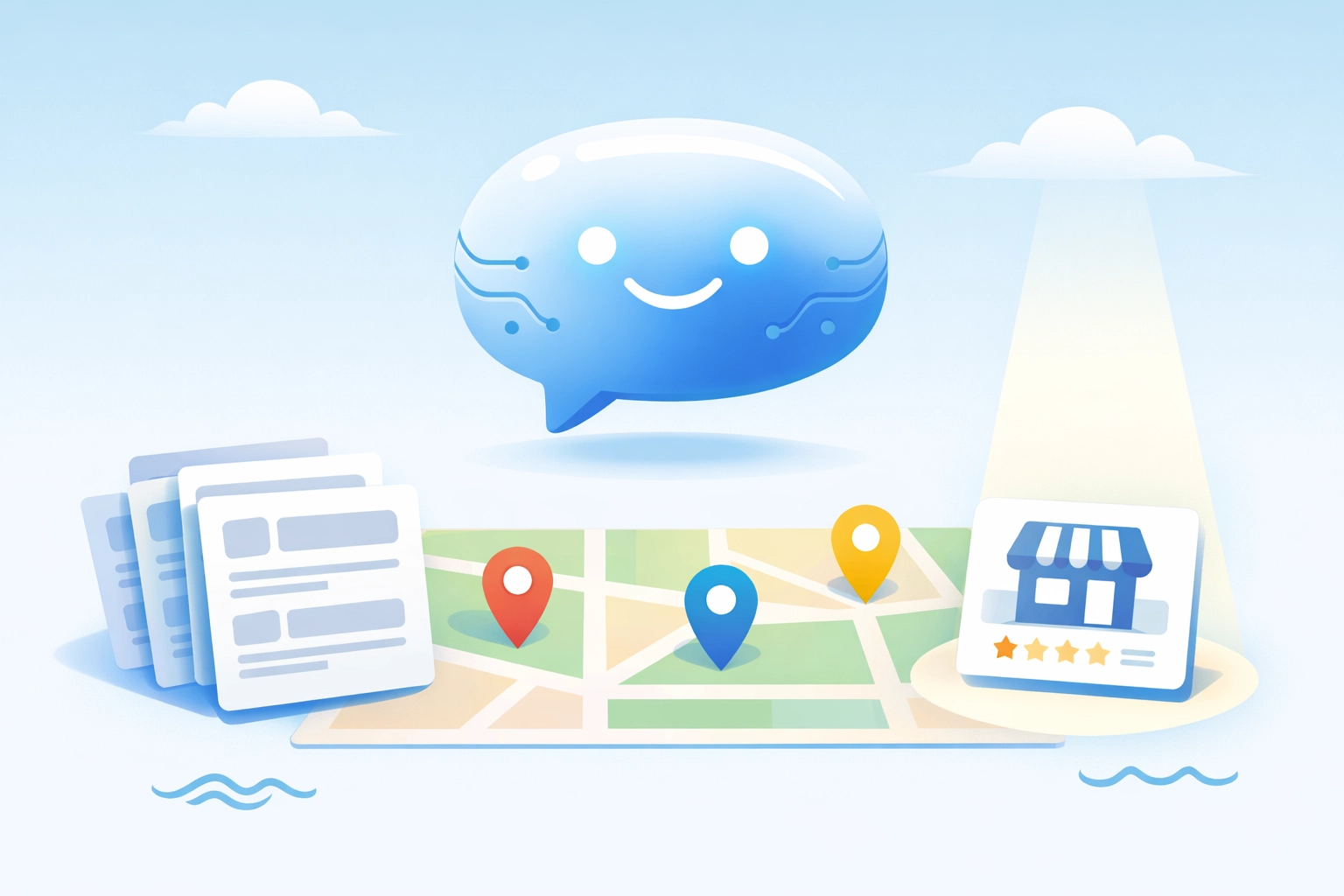
Think of your presence like a triangle:
- Google Business Profile (Maps)
- Your website (mobile-first + fast)
- Local proof (reviews, photos, mentions across the web)
Nail those three and you’re not chasing leads, you’re attracting them.
Are you “Hidden on Maps”? Fix your Google Business Profile first
If you do one thing this month, do this: treat your Google Business Profile (GBP) like your digital storefront. In Venice and South West Florida, Maps results can drive calls the same day, especially for urgent services and “near me” searches.
Your Venice GBP checklist (quick wins that actually move the needle)
Set the foundation
- Use the real business name (no keyword stuffing)
- Choose the best primary category (this matters more than most people realize)
- Add secondary categories that match what you actually offer
Make it conversion-ready
- Add services/products (clear names, short descriptions, pricing when possible)
- Upload fresh photos weekly (exterior, interior, team, work in progress, finished results)
- Turn on messaging if you can respond quickly
- Add your booking/quote link (yes, even if it’s just a contact form)
Use Posts like mini ads
- Weekly offers, events, seasonal services, “before/after” spotlights
- Keep them simple. One goal per post.
Get serious about Q&A
- Seed common questions (parking, turnaround time, service area, warranties)
- Answer in your brand voice: friendly, helpful, local
“We updated our profile photos and services, and we started getting calls from people who said, ‘I saw you on Maps.’”
Reviews: the local trust engine
Reviews aren’t just about stars. They’re content (and AI reads them). Aim for a steady stream: not a big push once a year.
Ask for reviews that mention:
- The service performed
- The neighborhood/city (Venice, Nokomis, Englewood, North Port…)
- The outcome (“same-day,” “fixed the issue,” “clean install,” “great with kids,” etc.)
Simple review ask script (text/email):
“Thanks again for choosing us! If you have 60 seconds, would you leave a quick Google review and mention what we helped you with? It really helps other folks here in Venice find us.”

Is your website costing you leads on mobile?
Fast, mobile-first sites… win. Slow, clunky sites… leak money.
Here’s what we see all the time: a Venice business pays for ads or gets a nice bump in Maps visibility: then customers click through to a website that loads slowly, feels dated, or makes it hard to call.
Mobile-first design (what it actually means in 2026)
Mobile-first isn’t just “it shrinks to fit your phone.” It means the mobile version is the priority.
Make these non-negotiable:
- Tap-to-call button visible without scrolling
- Contact form that’s short (name, phone, need)
- Readable font sizes, strong contrast (sunlight matters here)
- Simple navigation (Services, About, Reviews, Contact)
- Fast load time (especially on beach-town cell service)
What Venice customers expect instantly
When someone lands on your site, they’re subconsciously asking:
- Are you local?
- Can you help me with my specific problem?
- Can I trust you?
- How fast can I reach you?
Answer those in the first 10 seconds:
- Clear headline: what you do + where you do it
- One primary call-to-action (“Call,” “Request a Quote,” “Book”)
- Proof: reviews, badges, photos, short testimonials
If you want a clean baseline for your site experience, start with our homepage and navigation structure and make it your own: https://veniceislandmarketing.com/index.html
Why isn’t your local SEO working (even though you “did SEO”)?
Local SEO has two layers:
- Relevance (do you match the search?)
- Trust + prominence (does the internet believe you’re legit?)
In South West Florida, we also see a third factor: competition density. Some categories are packed. That means small advantages compound fast.
The local SEO system we use (simple, repeatable, future-ready)
1) Build location + service pages that match real searches
Instead of one generic “Services” page, create focused pages like:
- “Emergency Plumbing in Venice, FL”
- “Roof Repair in Nokomis”
- “IV Therapy in Venice Island”
- “Boutique Hotel Near Downtown Venice”
Each page should include:
- Who it’s for (the problem)
- Your process (what happens next)
- Local cues (service area neighborhoods, landmarks, typical timelines)
- FAQs (great for AI-era search)
2) Add schema (jargon… simplified)
Schema is code that tells Google what your page is: business, service, reviews, FAQs. It’s like labeling boxes when you move. AI and search engines love labels.
High-impact schema types:
- LocalBusiness
- Service
- FAQPage
- Review (where appropriate)
3) Strengthen your “local footprint”
Google wants consistency. Make sure your NAP (name, address, phone) matches everywhere:
- Website
- Google Business Profile
- Yelp, Apple Maps, Bing Places
- Local directories and chamber/community listings
Tiny mismatches add friction. And friction lowers rankings.

How do you market locally in Venice without wasting money?
You don’t need 12 channels. You need the right mix for Venice: where seasonality, events, and tourism can shift demand quickly.
Free visibility most businesses ignore: Venice MainStreet
Venice MainStreet offers real reach: especially during peak season.
Opportunities worth using:
- Free listing on VisitVeniceFL.org (reported 100,000+ monthly hits in season; ~30,000 off-season)
- Printed directory listing distributed widely (15,000+ copies)
- Downtown gateway LED sign for events/messages (free for qualifying items)
- Local events + sponsorships that put you in front of the community
The strategy: treat these like credibility boosters. They create local mentions and engagement that also supports SEO over time.
Paid ads that work (and the ones that usually don’t)
If you’re going to spend, spend where intent is high:
Usually strong:
- Google Search Ads (service keywords, urgent needs)
- Google Local Services Ads (if your category qualifies)
- Retargeting ads (bringing visitors back)
- Meta ads for promotions/events (especially seasonal)
Usually weak (unless you’re very strategic):
- Broad “awareness” ads with no offer
- Sending paid traffic to a generic homepage
- Ads without call tracking or conversion tracking
We believe every paid campaign should answer: what’s the next step and how do we measure it? Calls. Forms. Bookings. Not vibes.
How do you show up in AI answers (without chasing every new tool)?
This is the part that feels like “tech overwhelm,” so let’s simplify it.
AI systems summarize what they can verify:
- Clear services and locations on your site
- Consistent business details across the web
- Strong reviews and proof
- Helpful content that answers real questions
Do this to become “AI-readable” locally
- Add an FAQ section to key pages (pricing, timelines, service area, guarantees)
- Write in plain language (what you’d actually say to a customer)
- Use headings that sound like customer questions
- Keep your business info consistent everywhere
- Publish content with local specificity (Venice, Nokomis, Englewood… not “Florida”)
Try this content formula (it’s boring… and it works)
Post one piece per month:
- A local problem (e.g., “What to do when your AC stops cooling in July”)
- The simple steps
- When to call a pro
- Service area
- A clear CTA
That’s it. Watch rankings, Maps engagement, and calls climb steadily.
What should you do this week? A simple 7-day local growth plan
No massive overhaul required. Just momentum.
Day 1: Tighten your Google Business Profile
- Update categories, services, photos
- Add 5–10 FAQs
- Create 1 Post (offer or seasonal reminder)
Day 2: Fix your mobile homepage experience
- Add click-to-call
- Make your headline clear (service + location)
- Put reviews above the fold or close to it
Day 3: Create one “money page”
Pick your top service and build a dedicated page for it:
- What it is
- Who it helps
- Your process
- FAQs
- CTA
Day 4: Set up tracking (so you stop guessing)
- GA4 + Google Search Console
- Call tracking number (if you run ads)
- Track form submissions
Day 5: Ask for 3 reviews
Text customers you know were happy. Keep it personal.
Day 6: Add one local citation/listing
Start with the big ones, then layer in local directories.
Day 7: Publish one short local post
One question. One clear answer. One CTA.
“Once we stopped trying to do everything and focused on Maps + mobile + reviews, the leads got way more consistent.”
How do you know if your marketing is working (before you burn a whole season)?
You don’t need a 30-page report. You need a few numbers that tell the truth.
Track these monthly:
- Google Business Profile: calls, direction requests, website clicks
- Search Console: impressions + clicks for service/location queries
- Website: form fills, calls, booking completions
- Reviews: count + average rating + keywords customers mention
- Lead quality: are you getting the right jobs, not just more messages?
If something is up but leads aren’t… that’s a conversion problem.
If leads are up but rankings aren’t… that’s likely paid or referral-driven.
If nothing is up… you’re probably not visible yet (or you’re visible in the wrong places).
Want a future-ready local marketing system built for Venice?
This doesn’t have to be hard. You don’t need to master AI, redesign everything, and post on five platforms a day. You need a local system that’s clear, trackable, and built for how people search now: especially here in Venice and across South West Florida.
If you want help turning your website, SEO, and Google Business Profile into one cohesive lead engine, we’ll assess what’s working, what’s leaking, and what to fix first.
Learn more → https://veniceislandmarketing.com/index.html